Ambiakshi Technology - Autonomous Agents & Intelligence
Enterprise AIOps, AISecOps & Self-Healing Systems

Predictive AIOps & AISecOps for Zero-Downtime Scale.

Transform complex cloud, Kubernetes, and LLM infrastructure from reactive firefighting into self-healing, predictive operations. Ambiakshi builds automated root-cause analysis swarms, real-time prompt firewalls, and predictive GPU autoscaling.

70% MTTR
Faster Incident Resolution
99.99%
Observability Uptime
100% Zero-Trust
Deterministic AISecOps
Ambiakshi Enterprise AIOps Command Center
AIOps Telemetry Stream Active
0 ALERTS PENDING
70%

Reduction in Mean Time to Resolution (MTTR)

99.99%

Autonomous Self-Healing Reliability

45%

GPU & Cloud Compute Cost Optimization

<100ms

Real-Time Guardrail Threat Interception

AIOps Capabilities

Engineering High Availability for Autonomous Workloads

From predictive telemetry to autonomous self-healing microservices and zero-trust security guardrails.

01

Autonomous Incident Triage & RCA

Sub-Minute Root Cause Discovery Across Multi-Cloud

Replace noisy alert storms with intelligent telemetry swarms. Our agents correlate OpenTelemetry logs, metrics, traces, and Kubernetes events to diagnose failure modes in seconds.

Distributed log & trace correlation via vector anomaly models
Autonomous generation of remediation scripts and pull requests
Contextual alert deduplication reducing alert fatigue by 85%
Integration with PagerDuty, Slack, Datadog & ServiceNow
02

AISecOps & Enterprise LLM Guardrails

Zero-Trust Prompt Firewalls & PII Sanitization

Enforce military-grade governance on production AI pipelines. Intercept adversarial prompt injections, scrub sensitive PII, and apply deterministic output filters before user delivery.

Real-time OWASP Top 10 for LLM threat defense
Cryptographic audit trails & automated PII redaction
NeMo Guardrails & semantic boundary enforcement
Token consumption throttling & API abuse prevention
03

Predictive GPU & Cluster Autoscaling

Dynamic Compute Optimization & KV-Cache Management

Optimize inference throughput while cutting GPU spend. Our predictive scaling engine forecasts model traffic spikes, dynamically manages KV caches, and schedules spot instances.

Predictive vLLM and Ollama cluster elasticity
Dynamic KV cache eviction & batch quantization
Up to 45% reduction in recurring GPU infrastructure costs
Zero-downtime model swap & blue-green canary routing
04

Continuous Drift & Hallucination Telemetry

Automated Synthetic Benchmarking & Model Evaluation

Continuously evaluate production models against semantic drift, retrieval degradation, and hallucinations with automated synthetic testing harnesses (Ragas, TruLens, DeepEval).

Real-time embedding shift & data drift detection
Automated continuous evaluation against golden datasets
Closed-loop feedback pipelines for active SLM retraining
Custom compliance & accuracy scoring dashboards
Architecture Schema

The 4-Layer Autonomous AIOps & AISecOps Blueprint

A comprehensive view of how our telemetry pipeline ingests logs, correlates anomalies, executes self-healing runbooks, and enforces compliance.
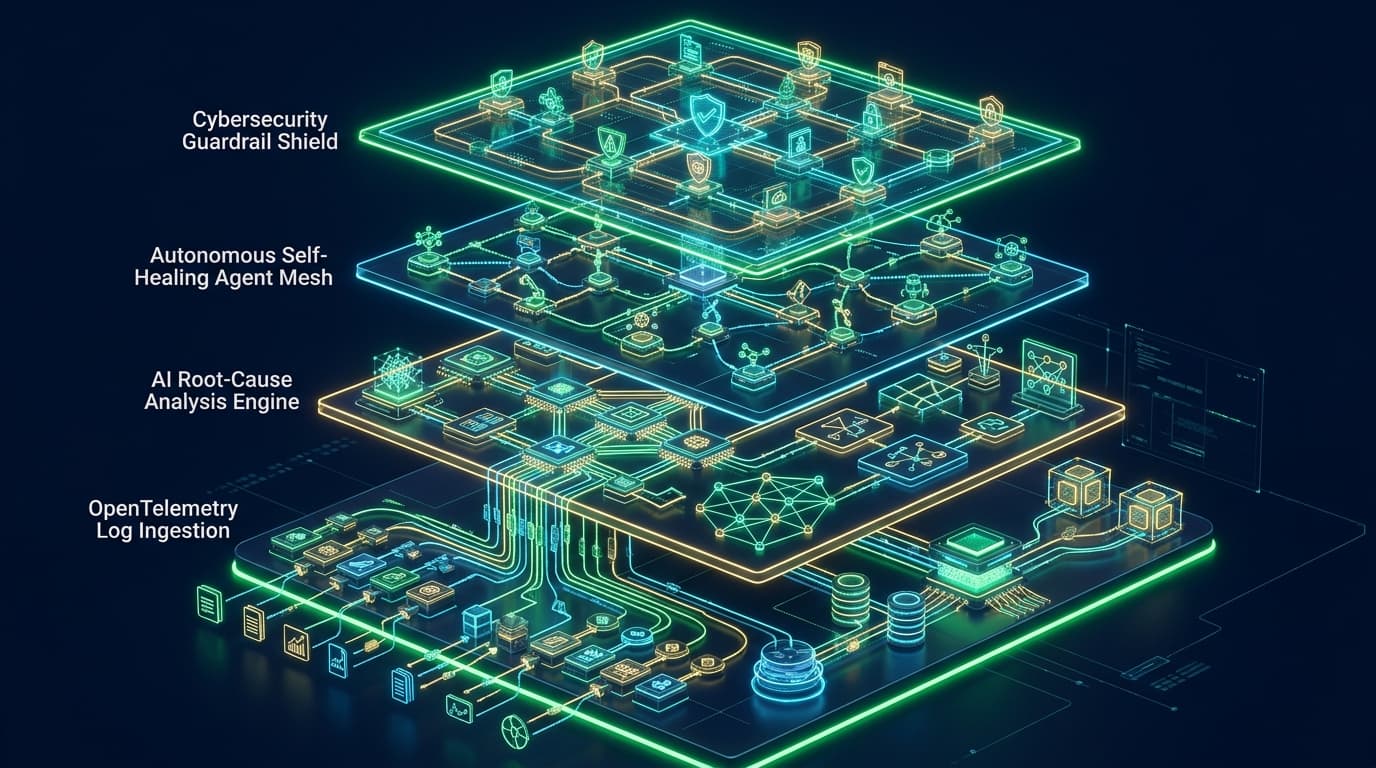
Enterprise AIOps and AISecOps Architecture Blueprint

Figure 1.0: Ambiakshi Full-Lifecycle AIOps & AISecOps Mesh

Layer 1: OpenTelemetry Log, Metric & Trace Ingestion

Ingestion Layer
High-Throughput Distributed Telemetry Fabric

Continuous streaming telemetry layer ingesting metrics, application logs, OpenTelemetry traces, network packets, and Kubernetes events from multi-cloud and on-premise clusters.

Layer 2: Cognitive Anomaly & Root-Cause Analysis Engine

Cognitive Engine
Vectorized Incident Topology & Causal Inference Models

Layer 3: Autonomous Self-Healing Agent Mesh & Remediation

Action Mesh
Stateful Auto-Remediation with Human-in-the-Loop Consensus

Layer 4: Cybersecurity Guardrail Shield & Compliance Gateway

Security & Governance
Prompt Firewalls, PII Masking & Cryptographic Audit Trails
Sector Operations

Proven Operations Across Mission-Critical Verticals

Explore how Ambiakshi protects and optimizes complex cloud environments across data-sensitive industries.

FinTech & High-Frequency Trading

Guaranteeing microsecond execution reliability, automated transaction anomaly resolution, and strict regulatory compliance.

Consult an Operations Architect
01. OPERATIONAL USE CASE

Sub-Millisecond Order Routing Diagnostics

AIOps agents monitor packet drops and trading gateway latency, dynamically rebalancing liquidity connections before slippage occurs.

02. OPERATIONAL USE CASE

Automated Ledger Deadlock Remediation

Predictive agents identify database lock contention in high-volume payment processing and auto-tune transaction queues.

03. OPERATIONAL USE CASE

Zero-Trust Financial API Guardrails

Real-time prompt firewalls block extraction of private banking credentials, financial records, and proprietary algorithm logic.

Deployment Roadmap

The 4-Stage AIOps Implementation Framework

A systematic engineering methodology ensuring seamless telemetry integration and zero-risk automated remediation.

01

Observability & Security Audit

Comprehensive assessment of your logging pipelines, OpenTelemetry instrumentation, alert noise, and AISecOps vulnerability surface.

02

Predictive Baseline & Sandbox Testing

Training custom anomaly detection baselines and stress-testing automated remediation workflows in an isolated staging sandbox.

03

Autonomous Remediation & Guardrail Rollout

Full production deployment of self-healing action swarms, Kubernetes controllers, prompt firewalls, and PII anonymization gates.

04

Continuous Observability & Model Tuning

24/7 telemetry monitoring, automated drift evaluation, active learning feedback loops, and infrastructure cost optimization.

AIOps, Observability & Guardrail Stack
OpenTelemetryPrometheusGrafanaDatadogDynatraceKubernetesvLLMRayLangSmithTruLensDeepEvalNeMo GuardrailsAWS CloudWatchAzure MonitorPagerDutyn8n Orchestration
Eliminate Production Downtime

Ready to Build Self-Healing, Autonomous Operations?

Connect with Ambiakshi’s Principal AIOps and Reliability Engineers to evaluate your telemetry architecture, design automated remediation swarms, or implement real-time LLM guardrails.